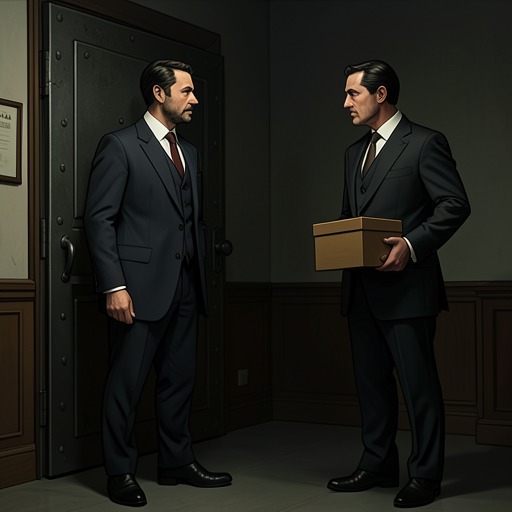
R.T. Straker and Mr. Barlow
'Salem's Lot: A NovelR.T. Straker and Mr. Barlow are presented as a tightly coordinated but asymmetrical commercial partnership: Straker serves as the visible negotiator, legal purchaser, and local intermediary, while Barlow remains absent yet directs the enterprise through his expertise and authority. Their acquisition of the Marsten House and the former Village Washtub is not merely a property transaction. It establishes the infrastructure for their arrival in Jerusalem’s Lot, converts Lawrence Crockett into an unwilling agent, and foreshadows the transformation of an apparently ordinary business venture into a source of menace.
Formation and Public Design
The partnership first becomes legible through Straker’s visit to Lawrence Crockett, the town’s second selectman and proprietor of Crockett’s Southern Maine Insurance and Realty. Straker arrives on a hot July afternoon in a sober three-piece suit, carrying a slim black briefcase and presenting an unnervingly controlled appearance. He does not study the local property photographs, offer a handshake, or exchange the ordinary courtesies of a prospective buyer. His silence and unreadable gaze immediately distinguish him from the usual customers Crockett knows how to assess.
Straker identifies two properties he wants: a business establishment a block beyond the Town Office Building, fronting the park, and the residence known locally as the Marsten House. The former business site is the long-defunct Village Washtub, a failed laundromat whose location Straker regards as useful. He states that he and his partner intend to open a business in town and live in the Marsten House. The proposed public identity is deliberately respectable: a furniture business carrying special antiques for collectors. Straker explains that Barlow is an expert in that field, making Barlow’s absence part of the partnership’s structure rather than evidence that he is uninvolved.
The business plan is also tailored to the town’s geography. Barlow has recognized that Jerusalem’s Lot lies on a highway used by tourists and summer residents, and the partners expect those travelers to provide most of their customers. The explanation gives their venture a plausible economic rationale, allowing a strange intrusion to pass as ordinary commercial development. The later shop announcement adopts exactly this surface: “Opening in one week. Barlow and Straker. Fine furnishings. Selected antiques. Browsers welcome.”
Division of Roles and Control
Straker is the partnership’s spokesman and executor. He supplies his full name, Richard Throckett Straker, and insists that all papers will be in his name. He handles the negotiation, presents the financial terms, signs the title documents, and later communicates with Crockett by letter. Barlow, by contrast, is consistently described as the absent partner, but his influence is unmistakable. Straker attributes the business strategy to Barlow’s knowledge and assigns the renovation work to him, stating that his partner plans to carry it out personally.
Their control extends beyond ownership. Straker tells Crockett that he will remain Barlow’s and Straker’s agent. From time to time, Crockett must respond to requests and arrange for laborers to bring “certain things” to the house or shop. He is explicitly ordered not to speak about these services. The demand turns a real-estate sale into a continuing obligation: Crockett has not simply transferred property but has placed himself at the partnership’s beck and call. The arrangement also makes secrecy a practical operating principle, with ordinary local labor and commerce recruited into work whose purpose remains concealed.
The partnership’s financial conduct reinforces this coercive structure. Straker offers only one dollar for the combined properties, despite the Marsten House’s asking price of fourteen thousand dollars and Crockett’s belief that the clients could be persuaded to accept somewhat less. When Crockett protests that the properties are worth far more, Straker coldly answers that the house and shop are worth millions and will become more valuable when a shopping center is built. His confidence suggests either privileged knowledge or a willingness to overpower ordinary valuation with intimidation. The paperwork is technically in order, and that legality becomes the mechanism through which the partnership gains power.
The Acquisition and Its Consequences
Crockett ultimately signs the title papers after consulting his Boston lawyer. The land associated with the projected Portland shopping center has been purchased by Continental Land and Realty, a dummy company occupying empty offices in New York’s Chemical Bank Building. This connection gives the transaction a larger commercial façade while deepening its artificiality: the partnership’s financial world is supported by nominal companies, distant offices, and documents that appear valid even when the institutions behind them are hollow.
Crockett recognizes the personal cost only after Straker places the ownership papers for the Marsten House and the former Village Washtub into his briefcase. He realizes that he has violated his own maxim, “You don’t shit where you eat,” and has made himself available to Straker and the absent Barlow. The sentence captures the partnership’s method. It enters the town through a transaction that looks like business, then converts a local official and real-estate broker into a dependent intermediary whose livelihood is now entangled with the newcomers’ demands.
For a time, Crockett experiences relief as summer turns to fall and winter, and he nearly succeeds in forgetting the deal. That relief ends when events begin to gather around the properties. Ben Mears asks whether the Marsten House is available for rental, and Crockett notices something peculiar in the writer’s look when he reports that it has been sold. Soon afterward, Straker sends a brief instruction requiring the shop poster to be displayed in the window. Crockett has Royal Snow put it up, thereby making the partnership’s public announcement part of the town’s daily landscape before the partners’ full significance is understood.
Narrative Function and Significance
The Straker–Barlow partnership operates through a contrast between ordinary language and concealed purpose. “Furniture business,” “fine furnishings,” “selected antiques,” and “browsers welcome” describe a familiar retail venture, yet the same men have chosen the Marsten House, a residence already burdened with local history and unease. The respectable shop and the ominous house are therefore two faces of one arrival: commerce provides the visible cover, while the residence supplies the private center of their operation.
The division between Straker’s presence and Barlow’s absence intensifies the partnership’s mystery. Straker can be questioned, negotiated with, and seen carrying papers, but Barlow’s power is conveyed through Straker’s references to his knowledge, plans, and partnership. Barlow is therefore established before appearing directly as an organizing force behind the transaction. The partnership’s structure delays full disclosure while making its consequences visible early: property changes hands, secrecy is imposed, local services are commandeered, and the shop’s name begins to circulate.
Their relationship also links the supernatural threat to the ordinary institutions of the town. The danger does not arrive outside the systems of property, law, tourism, and local employment; it uses those systems fluently. Straker’s valid papers, Barlow’s commercial expertise, the shell company connected with the Portland development, and the shop poster all allow the partnership to move through Jerusalem’s Lot under the protection of normal business forms. The result is a partnership whose decisive function is not simply to sell furniture and antiques, but to make an invasion appear legitimate long enough for it to take root.